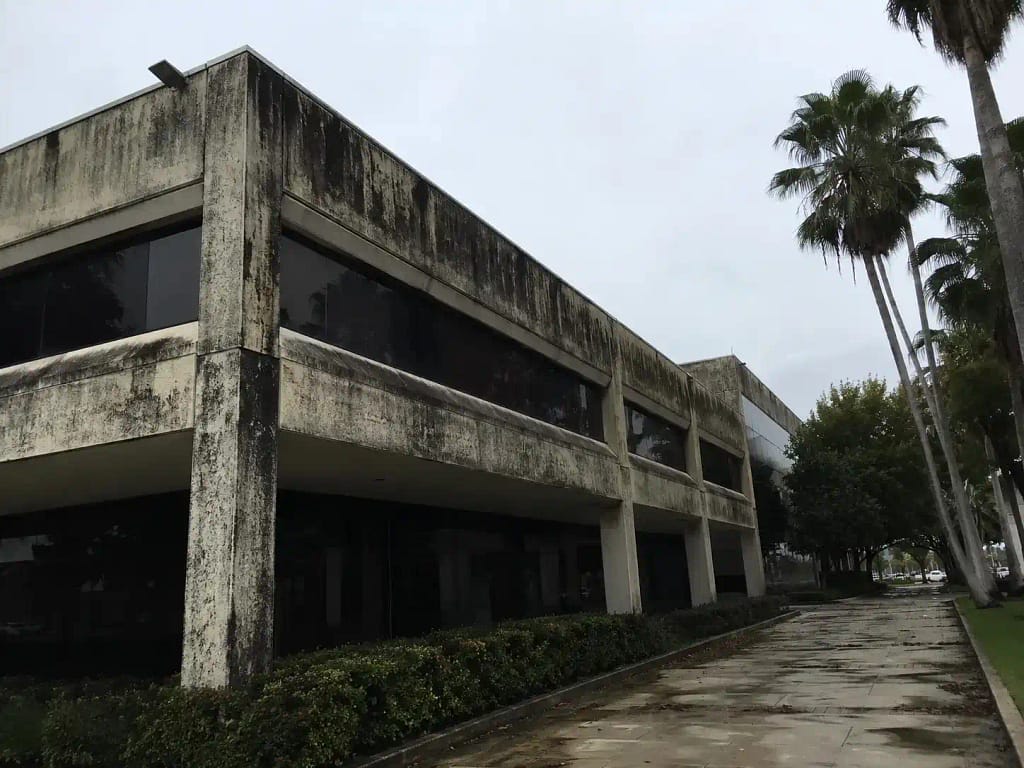
Mold in a commercial building is a liability issue in South Florida because property owners have a legal duty to maintain safe conditions for tenants, employees and visitors. Florida courts have awarded settlements from 435,000 dollars to 5.5 million dollars in mold-related commercial property cases. South Florida’s year-round humidity, heavy rainfall and hurricane season make biological growth and moisture intrusion ongoing risks that require documented preventive maintenance to manage legally and financially.
Mold in a commercial building is a liability issue because property owners and managers in Florida have a legal duty to maintain safe, habitable conditions for tenants, employees and visitors. When mold develops and is ignored, that duty is breached. The legal and financial consequences that follow can far exceed what proper maintenance would have cost.
South Florida Is One of the Hardest Environments for Commercial Buildings to Stay Mold-Free
Miami-Dade, Broward and Palm Beach counties average over 60 inches of rainfall per year. Coastal humidity stays elevated year-round. Hurricane season from June through November brings prolonged moisture intrusion events that test every building envelope, roofing system and drainage line on a commercial property. When those systems are not maintained, moisture accumulates inside wall cavities, ceiling tiles, HVAC ductwork and mechanical rooms. Mold spores, which are naturally present in South Florida’s air, colonize any surface that stays damp long enough.

What makes this especially relevant for commercial property owners is that mold growth in South Florida is not primarily caused by dramatic events like flooding. It is caused by small, ongoing failures: a slow roof leak that goes unreported for a season, condensation from an aging HVAC system that drips into insulation, a building facade with deteriorating sealants that allows moisture intrusion through the wall. These are maintenance failures. And in Florida, maintenance failures that lead to mold exposure are actionable.
What Florida Law Says About Mold and Property Owner Responsibility
Florida does not have a single mold statute. Liability for mold damage and exposure in commercial buildings is determined through negligence claims, breach of contract, premises liability and landlord-tenant law. The legal test is straightforward: the property owner or manager had a duty to maintain safe conditions, they failed in that duty, the failure caused the mold problem, and someone suffered harm as a result. (Source: Ilabaca Law, Florida Mold Lawyer, 2026)
The courts have consistently held this standard against property owners and managers who ignored documented complaints. In South Florida, a jury awarded 5.5 million dollars to a resident whose repeated mold complaints were dismissed by building management and went unaddressed for years. A Delray Beach commercial tenant secured a 435,000 dollar settlement after being forced to vacate a toxic workspace where mold, asbestos and VOCs made the premises uninhabitable despite repeated complaints and requests for remediation. (Source: Insurance Journal, 2023; The Mold Lawyer, 2025)
The pattern in both cases is the same: awareness plus inaction equals liability. Knowing about a mold problem and failing to address it is the foundation of most successful mold claims against commercial building owners in Florida.
The Four Liability Risks That Matter Most to Commercial Property Owners
1. Tenant and Employee Health Claims
Mold spores including Stachybotrys chartarum, Aspergillus and Cladosporium affect indoor air quality and cause respiratory symptoms, allergic reactions and in prolonged exposure cases, serious health consequences. When employees, tenants or visitors experience health problems in a building with known mold issues, the property owner faces premises liability exposure. Under Florida law, property managers in multi-unit commercial buildings can share this liability alongside building owners when maintenance responsibilities are part of their scope. (Source: Flaxman Law Group, 2026)
2. Tenant Complaints and Lease Disputes
A commercial tenant who documents mold complaints that go unaddressed has grounds to pursue breach of the covenant of quiet enjoyment, lease termination without penalty, and damages for business disruption. The 435,000 dollar Delray Beach settlement arose from exactly this scenario. For property managers and building owners with multiple commercial tenants, a single unresolved mold situation can trigger a lease dispute that affects vacancy rates, lease renewal negotiations and the building’s net operating income.
3. Insurance Complications
Florida insurance policies do not provide standalone mold coverage. Mold is treated as consequential damage, meaning coverage depends on what caused it. If mold developed from a covered water event such as a roof leak or burst pipe, remediation may fall under that claim. If the cause is deferred maintenance, insurers have grounds to deny the claim entirely. Commercial property owners in South Florida who delay exterior maintenance, roof inspections and building envelope repairs are not just risking mold. They are risking an uncovered remediation bill. (Source: Ilabaca Law, 2026)
4. Reduced Property Value and Asset Deterioration
Beyond legal claims, active mold growth in a commercial building reduces appraised value, complicates sale or refinancing, increases capital expenditure requirements and accelerates structural deterioration. Mold damages drywall, ceiling tiles, insulation, flooring and HVAC components. A mold remediation project in a commercial building in South Florida can run from tens of thousands of dollars into six figures depending on how far the growth has spread before it is addressed.
Where Mold Typically Starts in South Florida Commercial Buildings
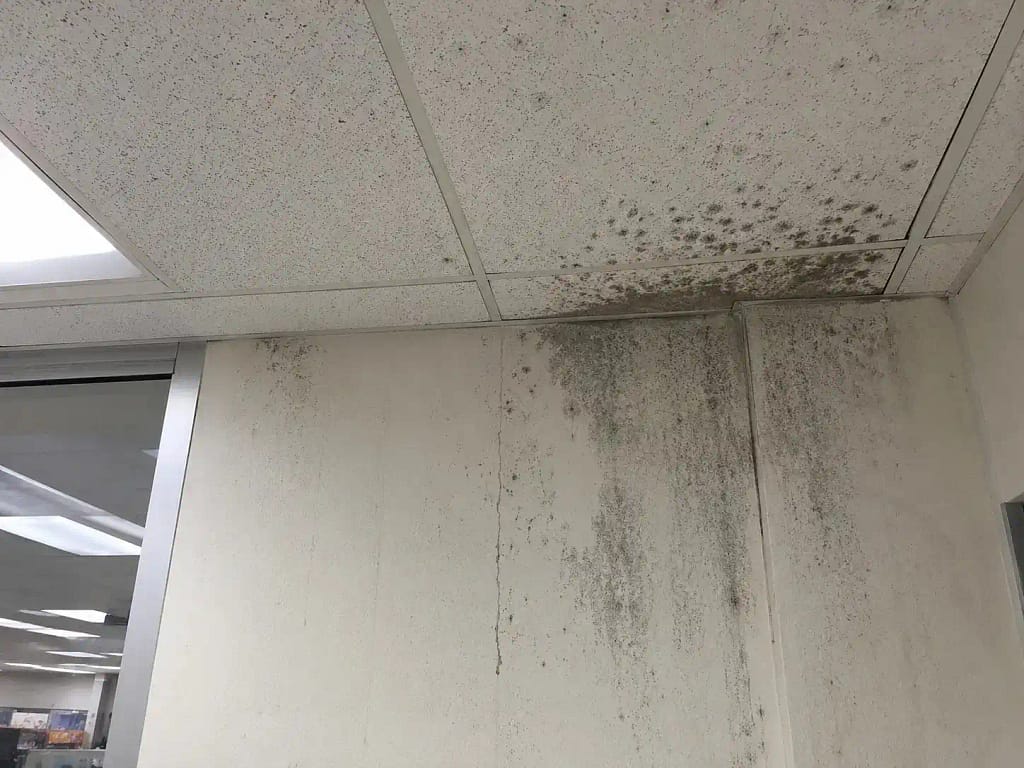
Understanding where mold begins is what allows property managers and facility managers to interrupt it before it becomes a liability issue.
- Building envelope failures are the most common entry point. Deteriorating sealants around windows and doors, aging EIFS or stucco exterior walls, and damaged flashing allow moisture intrusion that travels into wall assemblies without any visible sign on the interior surface.
- Roofing system failures are the second most common cause. A commercial roof in South Florida that has not been inspected or cleaned allows biological growth, debris accumulation and standing water to compromise the membrane, creating leak pathways that deposit moisture directly into ceiling cavities.
- HVAC condensation in South Florida’s climate is significant. Air handling units working against high outdoor humidity levels generate condensation that, if drainage is not properly maintained, introduces moisture into ductwork and mechanical rooms continuously.
- Exterior surfaces including concrete walls, parking structures, walkways and loading docks that accumulate algae, mildew and organic growth hold moisture against the building envelope. This is the least discussed entry point but one of the most preventable.
Prevention Is a Maintenance Strategy, Not a One-Time Fix
The most effective way to manage mold liability risk in a South Florida commercial building is through a documented preventive maintenance program. Courts and insurers both look favorably on building owners who can demonstrate that regular inspections, maintenance records and prompt responses to reported issues are part of standard operations. Awareness plus action is the defense. Awareness plus inaction is the liability.
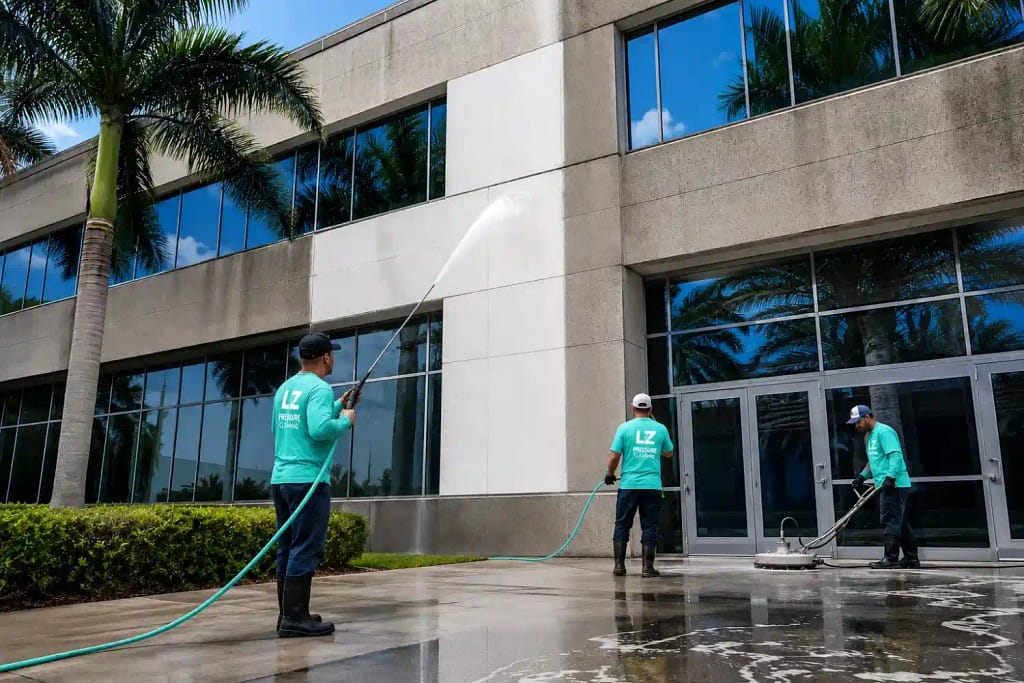
Routine commercial building cleaning and exterior maintenance removes biological growth, algae and mildew from building facades, walkways, parking areas and exterior walls before it becomes a moisture retention problem. In South Florida, where biological growth on exterior surfaces accelerates year-round, this is not cosmetic maintenance. It is the first line of defense against the moisture intrusion that leads to interior mold growth.
LZ Pressure Cleaning provides professional commercial building cleaning in Miami and across Miami-Dade County, removing algae, mildew, biological growth and surface contamination from commercial facades, parking structures, walkways, loading docks, storefronts and exterior walls as part of a broader preventive commercial property maintenance strategy.
What Property Managers and Building Owners Should Do Now
If you manage or own a commercial property in South Florida and cannot confirm when the exterior surfaces, roofing system and building envelope were last professionally inspected and cleaned, that gap in documentation is a liability exposure. The legal standard is not whether mold currently exists in your building. It is whether you took reasonable steps to prevent it.
A documented maintenance program that includes regular exterior building cleaning, roof inspection, moisture intrusion checks and prompt response to tenant complaints creates the record that demonstrates duty of care. It is also significantly less expensive than remediating an active mold situation or defending a premises liability claim.
Call (877) 658-5887 or get a free commercial building cleaning estimate in Miami online.
Why is mold in a commercial building a liability issue in Florida?
Florida property owners have a legal duty to maintain safe conditions for tenants, employees and visitors. When mold develops from a known maintenance failure and is ignored, property owners face negligence, premises liability and breach of contract claims. Florida courts have awarded settlements ranging from 435,000 dollars to 5.5 million dollars in mold-related property cases.
Can a commercial tenant sue for mold in Florida?
es. A commercial tenant who documents mold complaints that go unaddressed can pursue breach of the covenant of quiet enjoyment, lease termination without penalty and damages for business disruption. Florida courts have consistently held property owners and managers liable when awareness of a mold problem was combined with inaction.
How does routine exterior cleaning prevent mold liability in commercial buildings?
Biological growth, algae and mildew on exterior surfaces hold moisture against the building envelope and contribute to moisture intrusion inside wall assemblies. Regular commercial exterior cleaning removes this growth before it creates interior mold conditions, and creates a documented maintenance record that demonstrates duty of care under Florida law.